
Remembrance Day, Victory Day: What do May 8 and 9 mean for Ukrainians?
On May 8, Ukraine, in conjunction with countries of Europe and the United States, commemorates the bravery of those who fought against Nazism and all victims of the Second World War. This year, these days are once again commemorated during the ongoing war between Ukraine and russia, when the global threat of russian fascism once again poses a clear and present danger.
In Europe, May 8 is marked as the Day of Remembrance and Reconciliation rather than Victory Day on May 9. This is due to the immense tragedy the Second World War caused, with over 80 million lives lost. As a result, Europeans do not commemorate the war with parades or slogans such as “Never again.”
Simultaneously, Victory Day in the USSR and its constituent countries was celebrated on May 9. The regime that had been ruling in the USSR devised a memorial day to commemorate the victory over Nazism, dubbed “Victory Day.” Celebrations began in 1965, two decades after the war’s end, as a way to differentiate from the Western world, which had chosen to commemorate the war’s end on May 8. This date of May 9 was chosen to give the Soviet regime a more favorable image than the oppressive and totalitarian Nazi regime.
It should be noted that russia has engaged in various forms of propaganda, which have, in turn, resulted in public confusion surrounding the terms Fascism and Nazism. Although both these ideologies were prevalent during World War II and Italy and Germany had established an alliance, they should be understood differently.
- Fascism was widespread in Italy and meant the formation of a corporate state.
- After all, it was Nazism that ruled in Germany, which assumed the supremacy of one race over another. Nazism is defined as “national socialism,” and the Soviet Union had been attempting to build a socialist society and did not wish to be associated with the Nazi ideology, thus deliberately avoiding using this term.
It is also noteworthy to recognize the distinction of symbols for each day.
- The St. George ribbon is a widely-acknowledged emblem of Victory Day in post-Soviet countries, mainly in Russia. Yet, its origins are traceable to the time of Empress Catherine II when it was part of the Soldier’s Order of St. George the Victorious. This ribbon is, therefore, not associated with the victory in World War II. Yet, it is widely seen today as the new russian swastika, featured on soldiers’ uniforms, the clothes of women and children, and even on equipment.
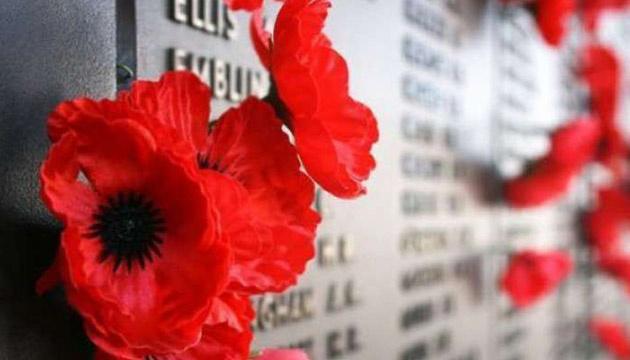
- Instead, in the rest of the world, the red poppy symbolizes the Day of Remembrance and Reconciliation. Symbolically representing the horrors of war and the ultimate hope of a world free from violence, the poppy has come to signify a commitment to peace and a reminder of the devastating effects of war.
Ukraine and Russia part ways: what happens next?
Annually, russia organizes grandiose military and aviation parades to emphasize its power and grandeur and support the propagandistic narrative of a single-handed victory in World War II.
russia “privatized” the victory holiday, turning it into an element of its state ideology to conduct an aggressive policy in our time, particularly against Ukraine. Following the propagandist lead of “defeating fascism in World War II,” russia now utilizes this narrative to “sell” the idea of the war against Ukraine to its population, as according to russian propaganda, Ukraine, as well as other Western countries, is fascist.
It must be noted that the victory over Nazism was only possible through the collective efforts of numerous countries and their respective populations. No country can claim recognition of its own exclusive role in the victory over Nazism.
In the russian federation, the commemoration of the victory over Nazism has gradually developed into a cult-like phenomenon of “victory obsession.” This phenomenon is used to promote war, the exaltation of one’s own people, to assign the status of a “main winner,” to justify the aggressive ideological mobilization of citizens, and to foster irresponsible and baseless revanchism.
On the Day of Remembrance and Reconciliation, Ukrainians commemorate not the triumph of the victors over the vanquished but a warning that dictators seek to satisfy their imperial ambitions by armed means, ultimatums, aggression, and annexation.
Ukrainians recognize that the most critical result of war is not the cult of victory but rather the ability to value peace and categorically and uncompromisingly defend it by all reasonable means.
In this spirit, Ukraine continues to fight to preserve peace, freedom, and democracy against the imperial ambitions of the russian federation.
Source: Rubryka
Теги: Remembrance Day, Victory Day