

Fidias Panayiotou Backs Keeping Abducted Ukrainian Children in Russia—What Is He Overlooking?
Putin launched his imperial conquest to first and foremost dominate the Ukrainian people, and he recognized that to deprive Ukraine of its children would be to deprive it of its multigenerational potential. When Russian troops rolled across the border into Ukraine on the night of February 24, 2022, the groundwork for the massive deportation of Ukraine’s children was already in place. Ukrainian human rights activists uncovered Kremlin documents dated February 18, 2022, which laid out plans to remove Ukrainian children from orphanages in occupied Luhansk and Donetsk oblasts and bring them to Russia under the guise of “humanitarian evacuations.” These documents revealed that Russia planned to target vulnerable Ukrainian children, especially those without parental care before the full-scale invasion had even begun. In the subsequent three years, Russia has embarked on a Kremlin-directed, deeply institutionalized project to abduct Ukrainian children and forcibly turn them into the next generation of Russians.
Ukraine has been able to verify Russia’s deportation of 19,456 children to date, although the true figure is likely to be much higher because Russia frequently targets vulnerable children without anyone to speak for them.[1] Yale’s Humanitarian Research Lab placed the number of deported children closer to 35,000 as of March 19, 2025.[2] Putin’s Children’s Rights Commissioner Maria Lvova-Belova (against whom the International Criminal Court issued an arrest warrant in March 2023 for her role in abducting children alongside Putin) claimed that Russia has “accepted” 700,000 Ukrainian children between February 2022 and July 2023—a terrifying benchmark for the lengths that Russia is willing to go to rob Ukraine of its own people.[3] The true number of deported children is near-impossible to verify, but the implication remains the same—Russia has stolen tens, potentially hundreds of thousands of Ukrainian children with the explicit intent of eradicating their Ukrainian identities and turning them into Russians. International law explicitly forbids the forcible transfer of children from one group to another group for the purpose of destroying, in whole or in part, a national or ethnic group, and considers these violations as constituent acts of genocide.[4]
Russia’s crimes against Ukrainian children have been remarkably well-documented, particularly by the perpetrators themselves. The Russian legal system made immediate accommodations for the intended influx of stolen Ukrainian children, signaling the intentionality behind Putin’s deportation project. Putin signed a decree in May 2022 providing for a simplified procedure for the acquisition of Russian citizenship for Ukrainian “children left without parental care and incapacitated persons,” which amounted to a legalization of the process of deporting Ukrainian children and forcibly granting them Russian citizenship.[5]
With the legal framework in place before the full-scale invasion, Russian occupation administrators and occupation officials have blatantly advertised programs that take Ukrainian children from their homes in occupied Ukraine to Russia under a variety of guises, such as camps for their supposed rest, relaxation, and rehabilitation.[6] As recently as March 19, 2025, Zaporizhia Oblast occupation head Yevgeny Balitsky announced that his administration, with financial support from the Russian Ministry of Education, plans to remove 70 children from occupied Zaporizhia Oblast to a Russian government-controlled children’s camp in occupied Crimea in order to give the children an opportunity to “rest and improve their health” after living in proximity to the frontline.[7] Russia has gone to great lengths to claim that these crimes are humanitarian gestures, but the legally-consistent humanitarian response would be to transfer Ukrainian children back to Ukrainian-controlled territory and return them to the care of their fellow Ukrainians—not deport them to the invading country.
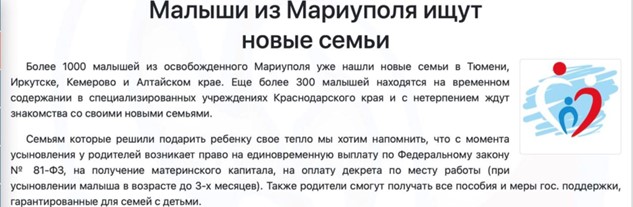
Children from Mariupol are looking for new families
More than 1,000 children from the liberated Mariupol have already found new families in Tyumen, Irkutsk, Kemerovo, and the Altai Krai. Another 300 children are currently in temporary custody in specialized institutions of the Krasnodar Krai and are eagerly awaiting to meet their new families.
For families who decide to give a child their warmth, we would like to remind you that from the moment of adoption, parents are entitled to a one-time payment under Federal Law No. 81-FZ, to receive maternity capital, and to paid maternity leave at the place of employment (if adopting a child under the age of 3 months). Parents will also be eligible for all benefits and support measures guaranteed for families with children.
Author screenshot of the Krasnodar Krai Regional Administration page on August 23, 2022. Translation: “Kids from Mariupol are looking for new families.”
Russia’s abduction of Ukrainian children inflicts lasting psychological impacts as children are forced to assimilate to life inside a hostile occupying power.[8] Yale’s Humanitarian Research Lab has confirmed that Russia is using at least 43 children’s camps throughout Russia to house deported children, at least 32 of which are explicitly “re-education” facilities.[9] At least one of these camps in Russia’s far eastern Primorsky Krai is physically closer to Alaska than it is to Ukraine. Russia uses these camps to indoctrinate Ukrainian children, punishing them for their Ukrainian identities and forcibly instilling pro-Russian sentiment through carefully curated Kremlin-approved curricula and “military-patriotic” training courses. Chechen Republic Head and close Putin ally Ramzan Kadyrov has lauded the “military-patriotic” training of abducted Ukrainian teenagers in Chechnya, for example.[10] Former Ukrainian Children’s Rights Commissioner Mykola Kuleba has termed these re-education programs as “death camps for Ukrainian identity.”[11]
Of the tens of thousands of children whom Russia has deported since 2022, a likely significant portion have been forcibly adopted into Russian families. Dmytro Lubinets, Ukraine’s Human Rights Commissioner, stated that Ukraine has confirmed at least 400 children whom Russian families have adopted, but as with estimated number of deportations, the true number of adoptions is likely to be much higher.[12] Within the first six months of the invasion, Russia’s Krasnodar Krai regional administration posted a quickly deleted advertisement claiming that there were over 1,000 orphans from occupied Mariupol alone “awaiting” adoption into Russian families. High-ranking Russian officials with close ties to Putin, such as Lvova-Belova herself and A Just Russia Duma Deputy Sergei Mironov, have adopted abducted Ukrainian children from occupied Mariupol and Kherson, respectively.[13]
The adoption process strips Ukrainian children of their Ukrainian names and birthplaces, replacing them with Russian birth certificates and documentation intended to erase the child’s Ukrainian identity and any paper trail that would allow Ukrainian authorities or family members to search for the child.[14] For teenage Ukrainian boys, their forced acceptance of Russian citizenship can result in a near immediate military summons to fight in the Russian army against their fellow Ukrainians—a completely separate but equally clear violation of international law.[15] The Russian adoption system is swallowing Ukrainian children up into a bureaucratic black hole, premised on the administrative eradication of Ukrainian identity. For the younger children, especially those adopted in their infancy, their adoption means that an entire generation of Ukrainians are growing up in Russia, unaware that they are Ukrainian.
An investigation by Ukrainian outlet Suspilne highlights ongoing Russian efforts to prepare Ukrainian children for service in the Russian military, notes the Institute for the Study of War (ISW).
Suspilne published a report on May 19 detailing how Russian Ministry of Defense (MoD)-run branches of the Nakhimov Naval School are training and recruiting Ukrainian children in occupied Sevastopol and Mariupol.[16] The Sevastopol branch of the Nakhimov Naval School has been actively training recruits since September 2014, after Russia’s illegal annexation of Crimea.[17] Cadets enter the school at age eight upon completing their fourth year of grade school, and then study and train for seven years, eventually going on to graduate and then enroll in Russian military academies.[18] Suspilne found that the curricula at the Sevastopol Nakhimov Naval School aims to instill in young cadets pro-Russian military-patriotic ideals, and also includes naval combat training.[19] Russian President Vladimir Putin ordered the creation of the Mariupol branch of the Nakhimov Naval School in March 2023, and the institution opened in 2024 and has since reportedly accepted 240 children aged 10 to 13.[20] The Mariupol branch, like the Sevastopol branch, seeks to train young children for eventual service in the Russian navy. The Mariupol school recently posted images of young children dressed in naval uniforms participating in an opening ceremony for a garden in honor of deceased Soviet and Russian veterans. Head of the Crimean “Almenda” Civic Education Center Mariia Sulyalina emphasized that Russia’s “militarization of education….is destroying Ukrainian identity” and preparing children to be “sent to war against their own country.”[21] ISW has reported at length on Russian efforts to militarize and indoctrinate Ukrainian children using various means in order to villainize and erase Ukrainian identity and prepare Ukrainian children to fight in the Russian military against their fellow Ukrainians.[22]
Russia also continues to militarize the curricula in non-cadet schools in occupied Ukraine and is leveraging its wider education policy in occupied territories to leverage schoolchildren in the production of military goods. Ukraine’s Permanent Presidential Representative in Crimea reported on May 19 that Russian officials are implementing the “Unmanned Technologies” project in schools in occupied Simferopol.[23] “Unmanned Technologies” claims to teach students in grades seven to eleven drone operation “through a combination of theory, practice, and competition.”[24] 192 children in Simferopol have reportedly gone through the program since 2024. ISW previously reported on Russian efforts to integrate Ukrainian children into Russia’s wider drone operator training ecosystem—of which the “Unmanned Technologies” program is evidently a part.[25] Russia is also using school-aged children to support in the production of military goods, suggesting that the militarization of schools in occupied Ukraine serves a twofold military preparation/recruitment and production purpose. Russia adopted a federal law on “involving schoolchildren in socially-useful work” in August 2023, and Ukrainian human rights activists have warned that Russia is using this law to force children in occupied Ukraine to produce goods for the Russian military under the guise of such production constituting “socially-useful” labor.[26] Ukrainian sources, including partisan groups active in occupied territories, have reported that Russian officials are forcing children to produce drone components and weave camouflage nets in schools regardless of the consent of their parents.[27] The implications of these educational policies will be far-reaching, as Russia is now actively militarizing an entire generation of young Ukrainians and attempting to turn them into the next generation of Russians.
Russia is once again preparing to escalate the forced removal and deportation of Ukrainian children during the upcoming summer months, emphasizes ISW. Russian First Deputy Education Minister Alexander Bugayev stated on April 27 that about 53,000 children from occupied Ukraine will “spend their summer holidays” in children’s camps throughout occupied Ukraine and the Russian Federation.[28] Donetsk People’s Republic (DNR) Head Denis Pushilin noted on April 22 that his administration will send 2,500 children to the “Artek” camp (occupied Crimea), the “Orlyonok” camp (Krasnodar Krai), the “Krasnaya Gvozdika” camp (occupied Zaporizhia Oblast), the “Smena” camp (Krasnodar Krai) and the “Alyye Parusa” camp (occupied Crimea), and will also continue to send teenagers aged 14 to 17 to Russia via the “University Shifts” program.[29] Pushilin also claimed that 13,000 children will “rest” (likely meaning attend various summer camps) in various Russian federal subjects (regions). ISW previously reported that Russia intends to deport 2,000 Ukrainian teenagers to Russia through the “University Shifts” program in 2025 alone.[30] International law notably differentiates between “forcible transfer/removal” and “deportation,” with “forcible transfer/removal” referring to occasions when the occupying power (in this case Russia) forcibly moves people within internationally-recognized national boundaries (in this case internationally-recognized Ukrainian territory), whereas “deportation” refers to the forced removal of individuals from outside of national boundaries.[31] Russian occupation authorities are both removing and deporting Ukrainian children to these summer camps, as ISW has previously assessed.[32] Both of these actions can rise to the level of a violation of international law.[33]
Such summer camps, whether in occupied Ukraine or in Russia, are re-education camps that aim to indoctrinate Ukrainian children through academic instruction, military training, and military-patriotic education. ISW has historically noticed an increase in the number of reported removals and deportations to such camps in the summer months, as Russian occupation officials are able to increasingly use the guise of summer vacation programs to facilitate the removals and deportations.[34] The Yale Humanitarian Research Lab (HRL) previously identified 43 such facilities, including 41 pre-existing summer camps in occupied Ukraine and Russia, which are involved in the removal/ deportation and re-education of Ukrainian children.[35] Occupation authorities are not only increasing the scale of these deportations but also institutionalizing them as part of a long-term strategy to separate Ukrainian children from their identity and more broadly Russify occupied Ukraine. These efforts are aligned with the Kremlin’s broader campaign to erase Ukrainian identity by assimilating the next generation of Ukrainians into a manufactured Russian national narrative that distorts Ukrainian historical memory, erases Ukrainian language, and conditions children to be loyal to the Russian state.

There can be no true peace in Ukraine without the return of the children that Putin has stolen. The fate of these children is inextricably tied to both the military and political outcomes of Putin’s war. Negotiations and an end to the fighting without consideration for the deported children will empower Russia to continue to commit these crimes with absolute impunity. A negotiated outcome to the war on any terms but Ukraine’s will result in the loss of Ukraine’s children, a loss that will be impossible to reverse.
For further reading on Russia’s illegal activities in the occupied areas of Ukraine, see: The Kremlin’s Occupation Playbook: Coerced Russification and Ethnic Cleansing in Occupied Ukraine
Source: Institute for the Study of War (ISW)