
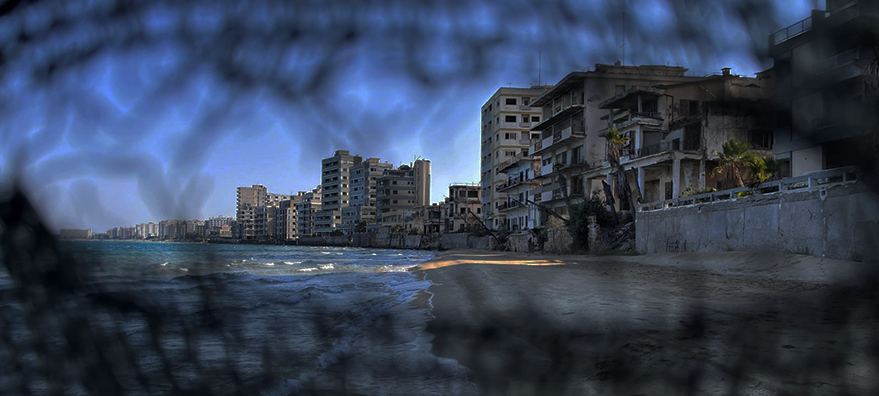
Famagusta
In this article, Vitaliy Portnikov explores Famagusta’s history as a poignant example of a long-standing political standoff that has endured for decades. He draws a parallel between Cyprus and the current situation in Ukraine, emphasizing that conflicts of this magnitude rarely have swift resolutions and often turn occupied territories into long-term foreign lands.
A multi-story confectionery—a paradise for anyone who knows what true happiness is. One floor of chocolate, another of cakes, and yet another of Eastern desserts… From the café’s balcony, there is an incredible view of the ancient city walls, where, legend has it, Othello himself once gazed out at the sea. It’s impossible to tear oneself away from this balcony or these delicacies—and yet, in the distance, the white, abandoned hotels of the resort zone loom, a desert formed after the war and the division of this beautiful island.
This is how I remember Famagusta, one of the iconic cities of the Mediterranean, whose name has become the title of a new series about the island’s division. The series was set to have its world premiere, but after protests from the Turkish government, Netflix canceled its release. Now, only viewers in Greece will be able to watch it. Yet the mere reaction to the series and the debate between Ankara and Athens remind us that some conflicts can last not just years, but decades—and may have no resolution.
Turkey’s invasion of Cyprus has always been justified by Ankara as a response to a coup attempt by radicals from the Greek community on the island, who sought to eliminate the Turkish population. I won’t recount the complex history of relations between Greeks and Turks on Cyprus here, as serious tensions between the communities existed long before this coup attempt. However, the facts show that the coup ended not only in the defeat of the rebels but also in the downfall of the dictatorial regime in Greece itself. Yet Cyprus’s sovereignty was never restored, and the Greeks expelled from the northern part of the island lost the opportunity to return to their homes or reclaim their property (the same, of course, happened to the Turks in the south). For 50 years, Turkey has refused to restore Cyprus’s territorial integrity, maintains an army in the northern part of the island, and has significantly altered the population’s makeup by encouraging settlers from mainland Turkey.
In 2014, the Russians, who rarely invent anything but often copy and steal, replicated Turkey’s military operation in Crimea. In Moscow, they also spoke of the dangers facing the Russian population on the Ukrainian peninsula, organized its “independence” proclamation, and annexed it to their own country (Turkey, to its credit, did not go that far). However, Turkey confidently calls Russia’s actions in Crimea a violation of international law—President Erdoğan made this clear again at the recent Crimean Platform summit and was remarkably convincing. At the same time, Erdoğan just as confidently advocates for international recognition of the Turkish Republic of Northern Cyprus, insisting that the only real solution to the Cyprus issue is the existence of two separate states on the island.
The 50-year division of Cyprus dismantles all the myths we hold about the possibilities of politically resolving Ukraine’s territorial integrity issues. Many believe that everything depends on Putin and the Russian regime, and that if the situation changes, everything could be resolved in a matter of days. But over the past 50 years, Turkey has seen countless presidents and prime ministers, and the country has changed dramatically since 1974. Yet one thing remains unchanged: Turkish society’s consensus on Cyprus and its support for Turkish Cypriots. Many believe that if Russia starts respecting international law, it will have to acknowledge the illegality of annexing Crimea and other Ukrainian regions. But Turkey respects and defends international law—except when it concerns its own interests. Who says it would be any different with Russia? Moreover, Turkey depends on the West far more than Russia. As a NATO country, it is, of course, part of the West. Before Erdoğan, this dependence and mutual affinity were even stronger. Yet no one in the United States or other NATO countries has been able to persuade Ankara to revisit the issue of Cyprus’s territorial integrity. All negotiations ended fruitlessly, and all peace plans proved unrealistic. When UN Secretary-General Kofi Annan finally organized a referendum on the island’s reunification, it ended in a complete and unexpected fiasco: most Turks voted in favor, while most Greeks voted against.
Why? Because the Greeks wanted not just a settlement, but a just settlement. They didn’t like the fact that Turkish (and Greek) troops would remain on the island after its demilitarization, or that the Turkish community would control more of the island than its population size would suggest. Nor did they accept that settlers from mainland Turkey would stay on Cyprus, living in homes taken from Greeks. Yes, the Greeks likely missed a historic chance to reunite the island and even return to Famagusta—which was also part of the plan. But if Ukrainians were offered the return of Crimea on the condition that the Russian Black Sea Fleet and settlers from Russia stayed there—how many of us would support such a wonderful plan? Personally, I wouldn’t. And neither would you.
So, we must draw a simple conclusion from the Netflix series Famagusta that we haven’t even seen: the territories we fail to liberate by force during this war, or in future conflicts with Russia, are unlikely to be returned through political means. Moreover, Russia will not only ideologically condition the population that remains but also deliberately alter the ethnic and political composition of the occupied territories, so that in 20 to 30 years, they will become a world even more distant from Ukraine than some place like Sudzha. We will not find any negotiating partners in Russia eager to return our lands. And even a major crisis in Russia won’t help—unless, of course, we can use that crisis to once again reclaim our territories.
We need to understand this so that after the war, we don’t live in a world of false hopes. Ukraine we preserve will be ours. Ukraine we don’t reclaim will become foreign for a long time—I hope not forever.
And, of course, if we truly continue to strive for a just peace, we must always resist Russia’s attempts—whether Putin’s or anti-Putin’s—to thwart our efforts to reveal the truth about the Russian occupation of Ukrainian lands or replace it with their own propaganda. We must realize that Russia without Putin could gain the same influence over Netflix that Turkey has under Erdoğan—and would readily use that influence.
Vitaliy Portnikov
15.09.2024
Source Zbruc.eu